Feature: LOIs and exclusivity
The owners decide each LOI. Not the inbox.
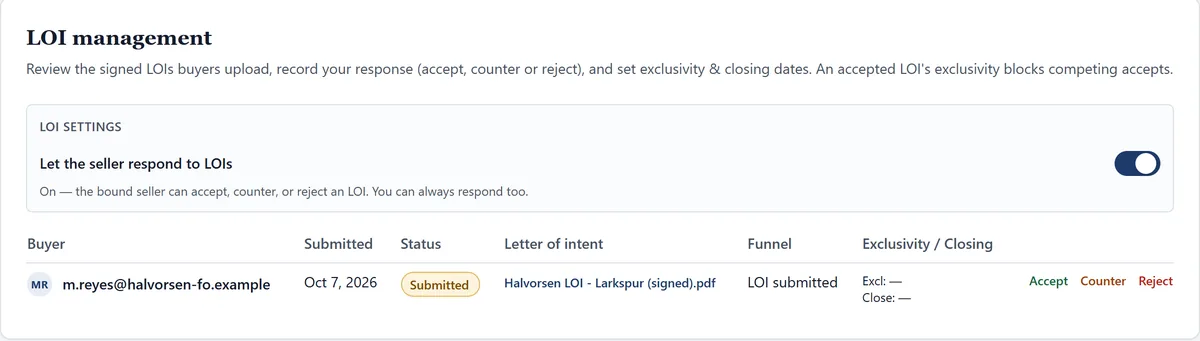
In ClosingVault the buyer uploads a signed LOI, and it is accepted, countered or declined only when owners holding more than half of the company approve. Accepting it starts exclusivity on a countdown, which pauses every other buyer’s access rather than ending it.
Last updated: 2026-11-03
What does owner-majority LOI approval do?
It puts the decision where it belongs. The room admin enters each owner with their share of the company, and the big decisions follow that share: an LOI, and every exclusivity start and extension, needs owners holding more than half of the whole company. A 50/50 split never approves on one vote; a single owner with 100% decides in one click. Counters, declines and every owner’s vote ask “Are you sure?” first.
How does it work, step by step?
- The LOI arrives. The buyer uploads the signed LOI document in the room.
- The room admin proposes. When a broker accepts, counters, declines or extends exclusivity, it is a proposal until the owners’ majority approves it.
- The owners vote. Each vote counts by ownership, until owners holding more than half of the company approve.
- Exclusivity is set. Accepting opens the exclusivity terms: when it starts and how long it runs.
- Other buyers pause. Their access pauses rather than ends, and comes back on its own if the deal washes out. A buyer team named on its email domain keeps access while everyone else is paused.
- The clock runs. A countdown keeps the room admin and the owners on the same date, and you choose whether buyers see it too.
On the record for every accepted LOI: the signed LOI and the acceptance, the exclusivity start date and length, the owners’ approval by ownership, and every extension and who approved it.
Why does it matter in a lower-middle-market deal?
Lower-middle-market companies often have more than one owner: two founders, a family, an investor with a stake. Decided by email and a phone tally, an LOI leaves no record of who agreed to what. In the room the broker never decides alone, so the client’s agreement to the dates is documented, not remembered. The seller’s team works in the seller portal and never binds the sale.
How is it different from other data rooms?
None of the seven low-cost rooms on our comparison, checked on their own sites on 2026-11-03, states receiving LOIs and deciding them by owner majority, or exclusivity that pauses the other buyers. In most rooms the LOI, the vote and the exclusivity dates live in email and a calendar; in ClosingVault they are part of the room’s record.
Owner-majority LOIs and exclusivity questions
We’re two 50/50 partners selling our company. Can one of us accept an LOI alone?
No. An LOI is accepted, countered or declined only when owners holding more than half of the whole company approve, so one partner’s 50% is never enough on its own.
I’m the broker. Can I accept an LOI on my client’s behalf?
You can propose it. When a broker accepts, counters, declines or extends exclusivity, it is a proposal until the owners’ majority approves it.
What happens to my backup buyers during exclusivity?
Their access pauses rather than ends, and it comes back on its own if the deal washes out. You choose whether buyers see the countdown.
I’m a buyer in exclusivity with a team at our fund. Does my whole team keep
access?
Yes, when the room admin names your buyer team on its email domain: the whole team keeps access while everyone else is paused.
Does the buyer type the LOI into a form?
No. The buyer uploads the signed LOI document itself, and that document is what the owners decide on.
Can someone on the seller’s team vote by mistake?
No. The seller’s team never binds the sale: they can upload, link documents, certify and answer questions, but they can’t decide, vote, set exclusivity or change the owners.