Why M&A deals fall through
Why do M&A deals fall through?
Many M&A deals that fall through die of the process, not the price. The common causes are poor communication, missing or late documents, surprises found late in due diligence, leaks of confidential information, co-owners who disagree on the LOI, deal fatigue, and a disorganized data room. Each one can be prevented by how the deal is run.
Last updated: 2026-11-03
7 common reasons M&A deals fall through
- Poor communication: nobody knows where due diligence stands.
- Missing or late documents during due diligence.
- Surprises found late in due diligence, after the LOI.
- A leak of confidential information breaks trust.
- Co-owners disagree on the LOI.
- Deal fatigue: the sale drags on and momentum runs out.
- A disorganized data room makes the business look badly run.
Reason 1 of 7
How does poor communication kill an M&A deal?
Poor communication kills an M&A deal by leaving each party to guess where due diligence stands. When the seller does not know what the buyer still needs, and the buyer does not hear back, silence reads as bad news. Doubt grows, and the deal starts to drift.
What it looks like
- The seller asks the broker “where are we?” every few days.
- The buyer re-sends requests because nobody confirmed what arrived.
- Status lives in one person’s inbox, and calls take the place of progress.
How to prevent it
- Send every party a written status update on the same day each week.
- In each update, list what came in, what is still missing and the dates to closing.
- Name one person who owns each open item.
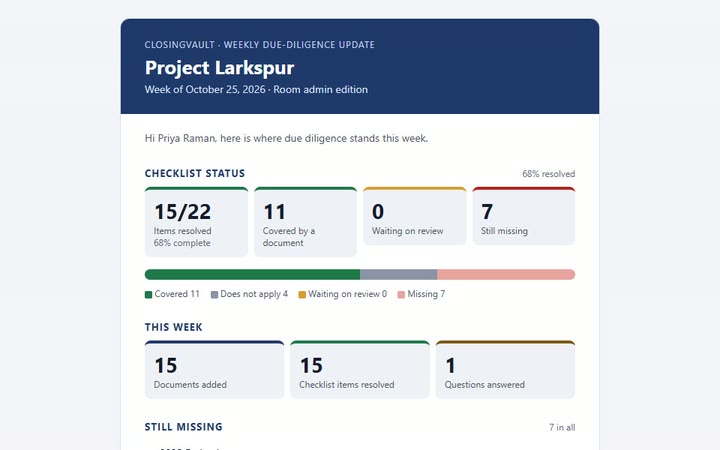
How ClosingVault handles it: Every Monday at 8, the broker, the deal team and each seller get their own one-page due-diligence update, built from the room itself, so nobody writes a status email. How the Monday update works.
Reason 2 of 7
What kills a deal during due diligence?
A common deal killer during due diligence is missing or late documents. Every week a request sits open is a week the buyer, the lender and the quality-of-earnings provider wait. A request nobody answers starts to look like something being hidden.
What it looks like
- The seller’s copy of the request list no longer matches the buyer’s.
- Some documents are sent twice and others never.
- Items with no answer sit open for weeks.
How to prevent it
- Work from one shared due diligence request list.
- Mark an item covered only when a document answers it.
- Close an item that does not apply with the seller’s written statement, not silence.
- Put a due date on each group of requests.
How ClosingVault handles it: Each document lands on the checklist item it answers and marks it Covered, the Missing count falls as documents arrive, and an item closes only with a document or the seller’s signed word that it doesn’t apply. How checklist filing works.
Reason 3 of 7
Why do business sales fall apart after the LOI?
Business sales often fall apart after the LOI because due diligence turns up something the buyer did not expect. A problem found in the last weeks lands when there is the least time to deal with it, and it makes the buyer ask what else they have not seen. The usual result is a retrade or a buyer who walks away.
What it looks like
- A tax notice, a lawsuit or a lost customer comes to light in the final weeks.
- The buyer asks for a lower price or new terms.
- The quality-of-earnings report does not match the numbers the buyer was shown.
How to prevent it
- Disclose known problems before the LOI is signed.
- Collect the financial, tax and legal documents before you go to market.
- Have the seller’s own advisors read the documents before the buyer does.
- Get every document in early, not in a rush at the end.
How ClosingVault handles it: The seller adds documents in batches as they turn up, each is filed the moment it arrives, and Ask the Data Room returns the documents that answer a plain-words question, such as “federal tax returns, every year”; you and your advisors read them.
Reason 4 of 7
Can a leak of confidential information end a business sale?
A leak of confidential information can end a business sale by breaking the seller’s trust in the process and, sometimes, in the buyer. Employees, customers or competitors who learn about a sale early can also hurt the business before it closes.
What it looks like
- Account numbers or customer financials turn up outside the data room.
- Staff or customers hear about the sale before the owner tells them.
- Files are forwarded with no record of who opened them.
How to prevent it
- Get an NDA signed before any confidential document is shared.
- Release documents in stages: the teaser first, the CIM after the NDA, full diligence after the LOI.
- Remove Social Security and account numbers before buyers see a file.
- Give each buyer access that ends on a date, and keep a record of who opened what.
How ClosingVault handles it: Social Security, card and bank account numbers are removed automatically before any buyer sees the file, every page viewed is stamped with the viewer’s name and the time, downloads are allowed person by person, and buyer access always ends: two weeks by default, two months at most.
Reason 5 of 7
Why do small business acquisitions fail to close when the owners disagree?
Small business acquisitions often fail to close when the co-owners do not agree on the LOI. A buyer who thinks they have a deal, then learns one partner never agreed, loses faith in the seller side. Co-owners who hear about an LOI only after it is signed tend to fight it.
What it looks like
- One partner negotiates while the others hear the terms second-hand.
- A signed LOI is reopened because a co-owner objects.
- The broker cannot tell who has the authority to say yes.
How to prevent it
- Before going to market, agree in writing which owners must approve an LOI.
- Show every owner each LOI before anyone answers it.
- Keep the decision with the owners, not the broker or the seller’s staff.
How ClosingVault handles it: The buyer uploads a signed LOI, and it is accepted, countered or declined only when owners holding more than half of the company approve; a broker’s acceptance is a proposal until then, and the seller’s team can’t vote. How LOIs and exclusivity work.
Reason 6 of 7
What is deal fatigue, and how does it kill a deal?
Deal fatigue is the loss of energy and commitment that sets in when an M&A deal runs long with no visible progress. The owner is still running the company, the buyer’s attention moves to the next target, and small disagreements start to feel like reasons to walk away.
What it looks like
- Replies slow from days to weeks.
- Exclusivity runs out with due diligence still open.
- Small points get argued that would have been waved through early on.
How to prevent it
- Set a start and a due date for each phase of due diligence.
- Agree an exclusivity period and keep its end date in front of everyone.
- Show every party what is left and when it is due.
How ClosingVault handles it: Accepting an LOI starts exclusivity on a countdown, each checklist phase has a start and a due date, and the deal dashboard shows every buyer’s stage, teaser to closing.
Reason 7 of 7
Can a disorganized data room scare off a buyer?
A disorganized data room can scare off a buyer, because buyers read it as a sign of how the company is run. Files named Scan_0417.pdf, the same statement three times and no way to tell what is missing suggest the books may be just as messy.
What it looks like
- Folders are sorted by who uploaded them, not by topic.
- Duplicates and vague file names fill the room.
- Nobody can say what is still missing.
How to prevent it
- Organize the room to a standard due diligence checklist.
- Name each file for what it is and the period it covers.
- Remove duplicates and keep a list of what is still outstanding.
How ClosingVault handles it: Every file is read, scans and zips included, exact duplicates are skipped, and each document is filed to the right folder and period, against the standard due-diligence checklist or your own Excel request list. Why a general-purpose drive falls short: professional virtual data room vs. cloud storage hack.
Definitions
- Deal fatigue
- Deal fatigue is the loss of energy and commitment among buyer and seller when an M&A deal runs long without visible progress.
- Retrading
- Retrading is when a buyer asks to lower the price or change the terms after the LOI is signed, usually because of something found in due diligence.
- Exclusivity (no-shop)
- Exclusivity, or a no-shop, is a period set in the LOI during which the seller agrees not to negotiate with or solicit other buyers.
- Due diligence request list
- A due diligence request list is the buyer’s list of documents and questions the seller must answer before closing, grouped by area such as financial, tax, legal and operations.
- Data room
- A data room is a secure online space where a seller shares deal documents with buyers and advisors, with control over who sees what and a record of who opened it.
Checklist: how to keep a deal from dying
Ten steps any seller, broker or buyer can take, with any tool.
- Send every party a written status update on the same day each week.
- Work from one shared due diligence request list.
- Collect the financial, tax and legal documents before you go to market.
- Disclose known problems before the LOI is signed.
- Get an NDA signed before sharing any confidential document.
- Remove Social Security and account numbers before buyers see a file.
- Agree among the owners, in writing, who must approve an LOI.
- Put a start and a due date on each phase of due diligence.
- Keep the exclusivity end date in front of everyone.
- Organize the data room to a standard checklist and remove duplicates.
Want the request list itself? Download the free due diligence checklist.
Questions about deals that fall through
I’m a business broker and my last deal died in due diligence after the seller
stopped hearing from anyone — how do I keep everyone on the same page?
Send each party a written status on a fixed day every week. In ClosingVault, every Monday at 8, the broker, the deal team and each seller get their own one-page update: what came in, what is still missing and the dates to closing.
I’m selling my HVAC company and the buyer keeps asking for documents I already
sent — how do I stop that?
Put every document in one room, filed to the request list. In ClosingVault each document lands on the checklist item it answers, and the buyer’s request list shows covered and missing at a glance.
We’re three partners selling our company and we don’t agree on the LOI — who
decides?
The owners holding more than half of the company. In ClosingVault an LOI is accepted, countered or declined only when owners holding more than half of the company approve, and the seller’s team can’t vote.
I’m a search funder and the seller’s numbers shifted after the LOI — how do I find
what’s in the documents before closing, not after?
Get every document filed early and ask for what you need. ClosingVault files each document as it arrives, and Ask the Data Room returns the documents that answer a plain-words question, such as “federal tax returns, every year”; you and your advisors judge what they say.
I’m selling my company and my last buyer tried to cut the price after the LOI —
how do I keep that from happening again?
Put known problems on the table before the LOI is signed. A retrade usually follows a late surprise, so collect the financial, tax and legal documents early and disclose what you know; ClosingVault files each document as it arrives, so the buyer sees it in the first weeks, not the last.
Our seller is worried a buyer will leak the financials to a competitor — what
protects them?
Watermarks, download control and access that ends. Every page viewed is stamped with the viewer’s name and the time, downloads are allowed person by person, and buyer access always ends: two weeks by default, two months at most.
We accepted an LOI and our backup buyers are getting restless — do they lose
everything?
No. Accepting an LOI with an exclusivity period pauses the other buyers’ access rather than ending it, and it comes back on its own if exclusivity ends.
I’m an M&A advisor and due diligence has dragged on for three months — how do
I get the deal moving again?
Put dates on what is left. In ClosingVault each checklist phase has a start and a due date, the Missing count shows what is still owed, and exclusivity runs on a countdown.
I’m a buyer in exclusivity — will ClosingVault tell me whether this deal is in
trouble?
No. ClosingVault’s AI organizes, never opines: it files and finds the documents and shows what is still missing, and you bring the judgment.
I’m a broker and our deal is already stalling in a Google Drive folder — can we
move it into ClosingVault mid-deal?
Yes. Drop the folder into a room and each document is filed to the checklist item it answers, then invite the buyers back at the stage they had reached; your part takes about 5 minutes.
More from ClosingVault
Keep your next deal alive to the close.
ClosingVault is the data room built only for lower-middle-market M&A. A room with the standard defaults is set up in about 3 minutes, sends the broker, the deal team and each seller the Monday update, files every document to the checklist and ends every buyer’s access on a date.
Start your 30-day free trial: 1 active deal room, up to 250 documents, no credit card. The firm that opens the room pays; invited buyers, sellers, owners and their teams are always free and unlimited.
Start free trial